Showing posts with label civil war. Show all posts

Tuesday, April 24, 2012

Book Review: Grant and Lee

At the beginning of the year, you may recall that I read and reviewed Ulysses S. Grant: A Victor, Not a Butcher. In that work, the author discussed some works that he had used as sources, and I read this descriptive bibliography assiduously and made notes of books that I would like to read that he mentioned. One of those books was Grant and Lee, by JFC Fuller. Thus, I was delighted when I saw this work on the shelves at Shiloh when I visited there earlier this month. I didn't even hesitate before picking it up, and I read it almost immediately (mostly because I started and then was hooked!) I'm currently reading another of his books, The Generalship of Ulysses S. Grant.

Book Review
Fuller, J.F.C. Grant and Lee: A Study in Personality and Generalship. Indiana University Press. 1957. 2nd Edition. 323p. Bibliography, maps, index. ISBN: 9780253202888.

Major General J.F.C. Fuller (British Army) began writing about the Civil War in the years after the first World War. Grant and Lee (first edition published 1933) grew out of research that he had done for his previous work, the The Generalship of Ulysses S. Grant. When he started these works, he held the view common to many people of them - and, despite almost a century of debunking, the views of many people now - that Confederate General Robert E. Lee was a brilliant strategist, tactician and general, and that Union General Ulysses S. Grant was a careless hack who would have failed to win the war if not for the North's vast wealth of resources and manpower. By the time he had finished his research, though, Fuller had done a complete 180 on his views of these two men. In Grant and Lee, Fuller uses extensive research - primarily using the Official Records of the War, various memoirs and biographies, and other sources commonly available at the time - to demonstrate how skillfully Grant managed his troops, and at the same time how often inept Lee was when times called for a forceful, decisive commander. The events are described chronologically, and the stories of both commanders are told simultaneously throughout the course of the war, alternating between each narrative when the two are in different theaters. Fuller's work is justly a classic of the field: his arguments are incisive, his research extensive, his historiography strong, and his own expertise as a general and theoretician help strengthen the validity of everything he says. What makes the book a delight to read, though, is his witty writing style and no-holds-barred willingness to state his opinion of his subjects. For example, when describing the Confederate plan for the second day of the Battle of Gettysburg, Fuller says flat out, "this was a thoroughly bad plan," and then goes on to explore the reasons why. In an age when much scholarly writing hems and haws at making value judgements, tip toes around directness, or provides "just the facts" and leaves the reader to draw their own conclusions, it is thoroughly refreshing to read Fuller's down-to-earth writing style. For that, and for the value of his insights, I found this book to be a page turner, and I read it in three days flat - and was reluctant every time I had to put it down.

A classic for all the right reasons, this is the book to hand any body who tries to tell you that Grant is a thoughtless butcher or that Lee is the greatest general in US History.

Rating: 5 out of 5.

Saturday, February 25, 2012

Google Maps: A Tool For Understanding a Battle

Without a good map, battles are nearly impossible to understand. There's just too much going on all at once, too many people moving in too many directions. Generally speaking, I define a book about a battle as successful or unsuccessful in large part by how well and how clearly the included maps help to clarify the description of the action taking place.

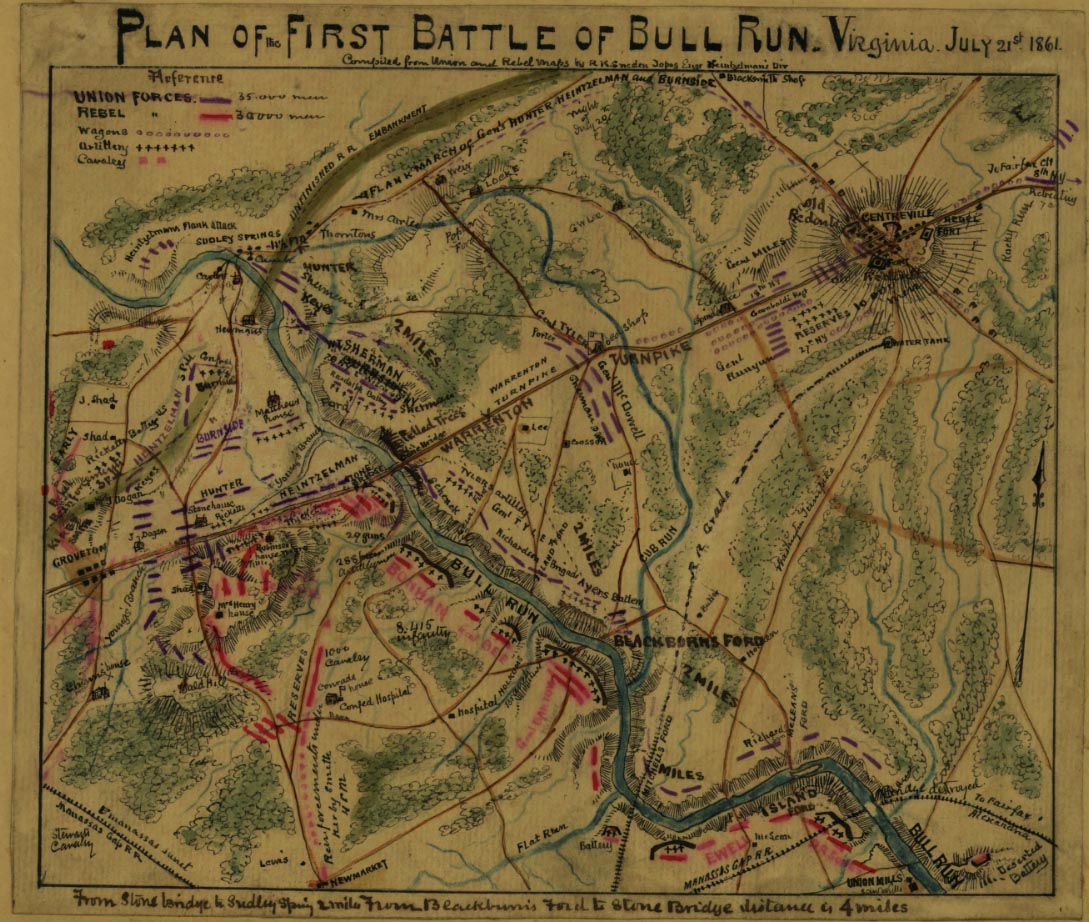
However, for those unfamiliar with battlefield maps, they can be very intimidating and unclear. Without a foundation of knowledge about the battle, this problem is exacerbated. For example, take a look at this map of the First Battle of Bull Run.


Plan of the First Battle of Bull Run, Virginia. July 21st 1861. Compiled from Union and Rebel Maps by R.K. Sneden, Topog. Engr. Heintzelman's Div. Accessed from the Library of Congress Maps Collection at this link.

What are we really looking at here? (if this is too small, access the original record at this link, or view the map here. There are some geographical features of the area - some water, some roads, some trees, kind of a funny looking thing up near the right hand top corner. There are some red lines and some blue lines, and a whole bunch of names. But what does all of this MEAN, and how does it help the viewer to understand the battle?

Not all maps are the same, of course, and while this one has a key, many do not, but there are a few things that are generally true. First, red is almost always Confederate Forces, and Blue is almost always Union Forces. Names given are generally of the brigade commander, but this is less universal and harder to rely on. Important places in general (such as the town of Centerville near the top right corner, or the Warrenton Turnpike, which runs diagonally across the map) are always shown, and places that are important in the battle (such as Blackburns Ford, in the lower center of the map) are also usually labeled. As with in any map, before even worrying about the details, it's worth examining it a few minutes and figuring out what it DOES tell you, such as - on this example - how the railroads are narked, what direction is north, and that the parallel lines along Bull Run denote the steepness of the banks, and that other hills such as the hill where Henry House is (on the left hand side just below center) is located.

For a battle map, the next step is to figure out where the conflict is actually taking place. While this might seem obvious, this is generally where the largest numbers of troops from the two sides are standing - but remember, these groups do not stand still. The only way to really understand a battle is to combine an examination of maps with a narrative account of the battle. Otherwise, for example, you can't tell that Sherman (in this map, the cluster of troops marked Sherman can be found just north of the Warrenton Pike, and on the east side of Bull Run) is soon to charge across a nearby ford and attack the Confederate forces on the other side of the river. A concise, simple description of the battle is of inestimable aid when staring at a map like this - but such a description is not for this blog post. Instead, I'm going to outline a strategy for helping a map like this come alive.

No amount of looking at this map will you tell you who these people were or what the land on which they stood really looked like. However, with the internet, you can get a long way towards doing understanding this better. This is where Google Maps comes in. By combining what a simple battlefield map such as this one can tell us with the plethora of images that can be found on the internet, those trying to learn about a battle can really get in-depth with it, by recreating this map using a custom Google Map. To do this, you will need to have a Google Account and be logged in. Then, go to www.google.com/maps. Select "My Places", then select "Create Map."


Once you have created your map, you fill in the name you'd like to use, and a description. If you are working with a group - for example, a class of students - you can also select "Collaborate," which will give you the option to share the map with any number of other people who can also add features to it.


Once you've got the basic set up, it's time to start adding things to your map! You can add either pins or lines, by using these two buttons:


The one on the left that looks like an inverted tear drop lets you drop a pin; the one on the right lets you draw a line! Dropping a pin looks like this:


You write in the name you want, and a description of the place. You can even copy and paste pictures in to the description! If you click on the representation of the pin in the upper right hand corner, you can change how the pin looks, too. In short, there are a LOT of options. Once you've created a pin, and added what you want, you can save it, and click "Done" over on the left (above the name of your map) and when you got to look, you'll see your pin - and when you click it, the description you wrote will pop up:


I popped in a picture of the Henry House that I took when I visited Bull Run last summer; scrolling down, there is a historical picture of how the house looked after the battle (you can see that image here.) Now you know the basics! Play around until your comfortable with it - Google gives a bunch more information on how to make custom maps here.

So, you've got a map. How can you use it to help teach about the Battle of Bull Run? Lots of ways!
  1. Have students figure out where important events took place, and place pins there.
  2. Track down images of important figures and sites around the battle field, and use them to illustrate the map (make sure you check copyright information on all such images before using them, though!
  3. Add historical data to the description.
  4. Use different colored pins to mark different kinds of locations.
  5. Collaboratively trace - using lines - the different ways that units came and went from the battlefield.


For getting images, I highly recommend using the Library of Congress American Memory online collection, which hosts a truly amazing number of resources of all kind related to US History, nearly all of which is in the public domain and therefore can be legally used (still cite your sources, though). Just search for what you're looking for!

That's a quick-and-dirty explanation of how Google Maps can be used to help clarify the use of battlefield maps. There's nothing like building your OWN map to help one understand where every one was, why they were there, and what the prominent features of the area were. Going through the process oneself can really help to elucidate maps that seem very cryptic when just glanced at. I've gone ahead and populated my Google Map of Bull Run with many more important features; you can take a look by going to this link. At the time of writing this, it's still a work in progress, but it does demonstrate the various possibilities described in this post!

Next time - more on Bull Run! A strategy for sorting out the confusing back-and-forth and timing issues that come up while trying to navigate this kind of map!

Wednesday, February 15, 2012

Book Review: Ulysses S. Grant: A Victor, Not a Butcher

I started off the New Year by getting back to reading about my favorite topic, the Civil War, after having read little in this area since September. I tackled first a book that I've wanted to read ever since I first saw it on the shelf a few years ago. There's something about a book titled "Ulysses S. Grant: A Victor, Not a Butcher" that is guaranteed to draw in a Grant enthusiast like myself. I'll admit I was eager to see one of my personal heroes acquitted of the title that he earned post-war when people looked back on charges like the second attack on the Vicksburg trenches or the poorly-executed attempt to break Robert E. Lee's lines at Cold Harbor. What I read didn't disappoint me; after finishing Bonekemper's book, I was left with a personal hero smelling perhaps a bit too much look roses...

Review

Bonekemper III, Edward H. Ulysses S. Grant: A Victor, Not a Butcher. Regnery Publishing, Inc. 2004. 453p. Photographs, bibliography, maps, index. ISBN: 9781596986411.


The thesis of this work is clearly stated in the title: to marshal evidence to dispel the persistent belief among the American public that Ulysses S. Grant, the general who led the Union forces to victory in the US Civil War, was an unskilled general whose poor leadership led to the needless sacrifice of thousands of soldiers. This view is generally contrasted with a far more flattering assessment of his opponent, Robert E. Lee, who is seen as a brilliant tactician. Bonekemper (military historian at Muhlenberg College, PA) uses a wide array of statistical information and extensive research of both period documents and modern histories to describe how the "butcher" myth came about and to thoroughly refute it. His treatment demonstrates clearly that Grant's casualty rates were comparable to other generals throughout the war, that he used tactics and maneuver much more often than brute force when facing an opponent army, and that his results were exceptional, including the capture of multiple opposing armies and the forced surrender of Lee's Army of Northern Virginia, which brought an effective end to the combat of the Civil War.

This is a solid piece of scholarship, aimed at a lay reader, and therefore treats most topics as if the reader knows little about them. It is written in an engaging and flowing style that draws the reader in, and Bonekemper makes each of his points in support of Grant with a flourish of style and wit. However, it is difficult not to notice that, in Bonekemper's assessment, Grant never does wrong; every decision is thoroughly defended and Grant is acquitted on all counts. It is easy to finish this work convinced that Grant hardly made a wrong step the whole war; even the disastrous first day at Shiloh is quickly explained away as not Grant's fault, while he receives full credit for the turn-around in Union fortunes the next day. In his effort to convince the reader that Grant is not, in fact, a butcher, Bonekemper at times loses sight that Grant did still make mistakes.

For a thorough re-assessment of the generalship of Ulysses S. Grant, taking in to account both the analyses of his contemporaries and the scholarship of prominent historians from the past 150 years, Bonekemper's work is excellent and readable. However, it is a work that is best read with an understanding that Bonekemper has an agenda, and has white-washed or hurried past (though not ignored!) information that would interfere with that agenda.

Rating: 4 out of 5